
Public assemblies on race and racism
About the project
Inspired by Gary Younge's article 'What Covid taught us about racism - and what we need to do now' (The Guardian, 2021) The Esmee Fairbairn Foundation funded a series of town hall meetings to elevate anti-racist discourse.
Conducted across the UK, and organised in partnership with local activist groups these public assemblies combine expert contributions from community practitioners and testimony from participants, to promote and amplify a discussion around racism and how it might be confronted. These conversations are grounded in facts and peoples’ experiences and, in so doing, circumvent the toxic, harmful or reductive narratives that are present in much of the mainstream press, broadcast and social media.
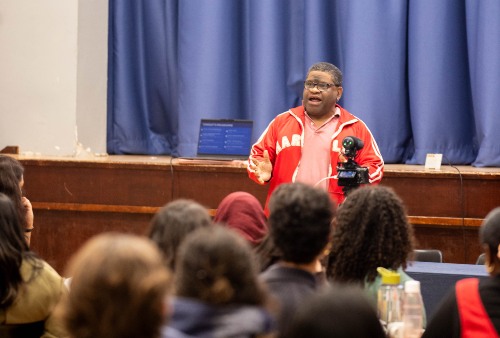
The public assemblies have different themes - decided locally by a steering committee - but follow a common format. We eat together, there are three community speakers who provide short ‘provocations’, followed by a period of open testimony chaired by a respected facilitator drawn from the area. We then discuss three questions related to the theme in small groups, whose responses are then fed back to the assembly. There is a local cultural contribution - singing or dancing - and a final summation or response to the event.
In order to include as many people as possible in these conversations, the meetings are documented and will be shared with the widest possible public through the channels of the partner organisations. We hope, but cannot guarantee, that concrete agendas for collaborative action emerge from these meetings. We believe that in the current climate, creating space for informed and engaged public discussion around racism is a valuable goal in itself.
The assemblies
Birmingham - Whose City Is It Anyway? (12 February 2025)
With 40 percent of its population under the age of 25, Birmingham is the youngest city in Europe, as well as being Britain's largest minority-majority city. Activists from within minoritised communities, who have been campaigning against racism for decades feel they needed to deepen the connections with a younger generation which had different reference points and experiences but were, ultimately, wedded to the same goals. Working with Birmingham Race Impact Group (BRIG), BRAP and the University of Warwick, we brought more than a hundred people, spanning all ages, together at the Old Library, in Digbeth, for an intergenerational exchange.
Questions:
- What major things do people of a different generation not understand about your own generation?
- What is the main obstacle to intergenerational cooperation across the city?
- What could we achieve if different generations in Birmingham work together better?
Glasgow - Still 'Nae Problem' Here? (27 February 2025)
In May 2021, when immigration officials swooped into Kenmure Street, Pollokshields in Glasgow, intent on detaining two men only to be met, and ultimately stymied by a huge, multi-racial, local protest, it signalled the potential for anti-racist resistance in Scotland. But alongside that lay significant denial about the levels of racism that persist in Scotland as well as the colonial roots from which it has grown. Working with Maryhill Integration Network, Identities Journal and the Coalition for Racial Equality and Rights (CRER), we brought around 150 people together for an assembly at the Renfield Centre, to discuss what the problem was and how we might confront it.
Questions:
- In 2025, how is racism in Scotland different compared to the past?
- What is the main obstacle to good race relations in Scotland?
- How can we encourage communities in Scotland to better work together to tackle racism?
Nottingham - Building Resistance (6 March 2025)
As a city, Nottingham finds itself in the crosshairs of a political, economic and social crisis. The city council is bankrupt, while the police and the health administration are in special measures. Amid the cuts and restructuring, it is the communities with the least resources that are being hardest hit. Nottingham, the site of the first post-war race riots in Britain in 1958, is home to one of the most established black communities in the country, but is all too often looked over in the national conversation. We worked with a number of individuals and organisations to bring around 100 people together for an assembly at Hyson Green Youth Club, to discuss how minoritised communities might resist the challenges posed by systemic failure in the city.
Questions:
- What are the main obstacles to racially minoritised communities building resistance in Nottingham
- What do we want from black and minority representatives and how can we get it?
- What kind of coalitions do we need to build in Nottingham to further the interests of our communities.
Pilot: Bristol (20 June 2023)
In 2023, working with the Black South West Network, we organised a pilot assembly around the theme ‘Memorialising the Future: What Does Bristol Want From Its Public Spaces?’. Julz Davis, a participant in the assembly wrote a summary of the event, with photos.
Series coordinators
Gary Younge is an award-winning journalist, author and Professor of Sociology at the University of Manchester. Winner of the 2023 Orwell Prize for Journalism and the 2025 Robert. B. Silvers Prize for Journalism, he has written six books and was formerly a columnist at The Guardian.
K Biswas is a critic who has written for the New Statesman, New York Times, The Nation, Le Monde Diplomatique, and the Times Literary Supplement. He is the Editor of Representology: The Journal of Media and Diversity, Chair of the charity Heard and Director of Resonance FM.
Bridget Byrne is a Professor in Sociology and Director of CoDE (Centre on the Dynamics of Ethnicity). She researches in the areas of cultural industries, citizenship and whiteness.